
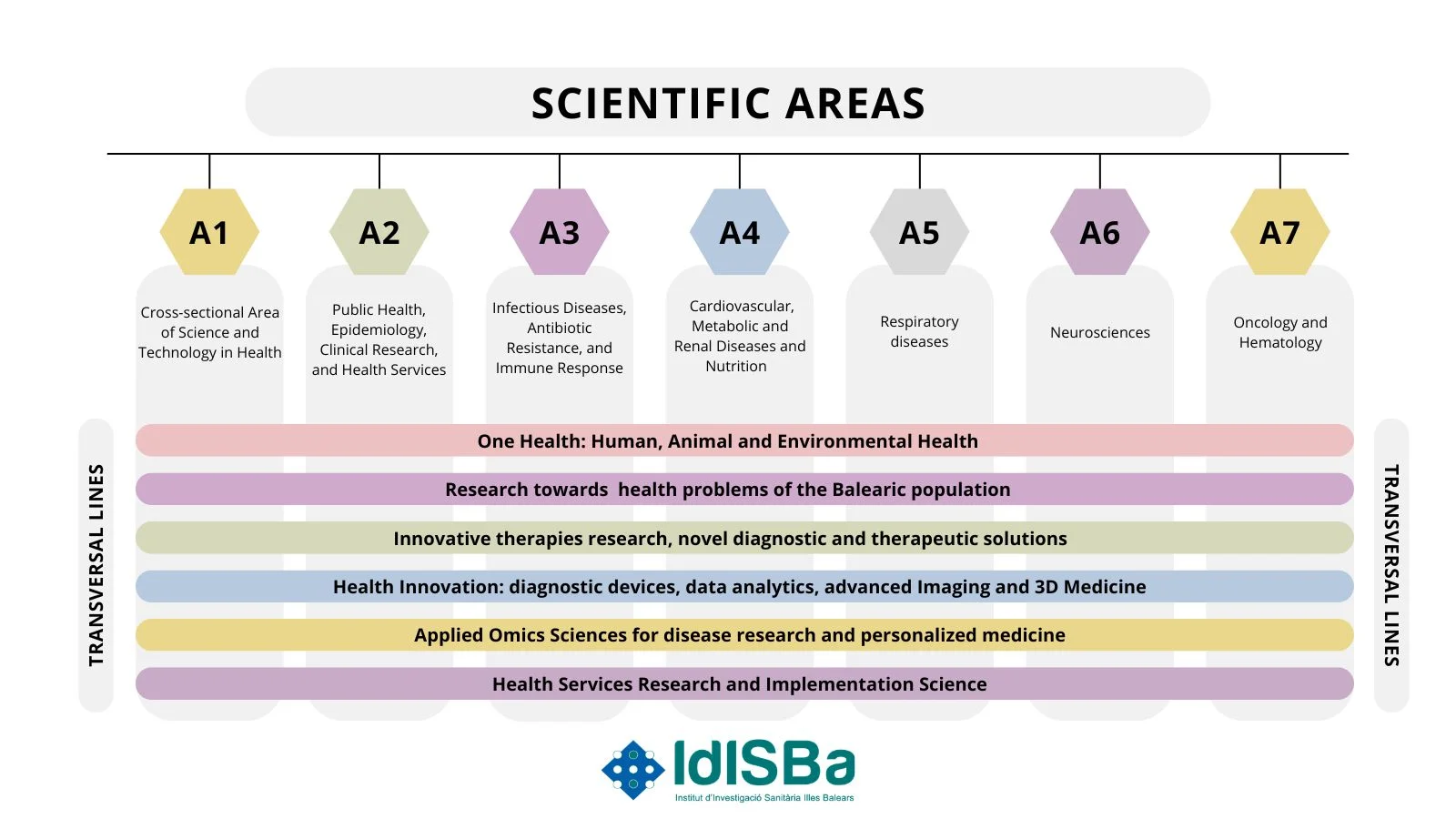
Shared Scientific Plan 2025-2029 is structured into 7 scientific areas and 6 transversal lines that connect different research groups and fields.
Scientific areas bring together teams around major common objectives, while transversal lines act as a backbone, facilitating collaboration both within and across research areas.
This structure ensures that the work of the different groups is coordinated and aligned through shared priorities, with the aim of maximizing synergies and achieving more concrete and impactful outcomes.
1. One Health: human, animal and environmental health
-
Multidisciplinary and collaborative research aimed at studying the interactions and interdependencies between environmental, animal and human health.
-
Impact on health and quality of life of exposure to chemical, physical and biological agents.
-
Social and community dimension of health: analysis of social inequalities in exposure to environmental risks and their impact on vulnerable communities, promoting participatory strategies to improve health and well-being.
This transversal line adopts the One Health approach, which recognises the interdependence between human, animal and environmental health, in order to promote multidisciplinary and collaborative research to study the interactions and interdependencies between these three domains.
This comprehensive approach enables the identification of the impact of exposure to chemical, physical and biological agents on health and quality of life, taking into account how environmental and zoonotic factors may influence the onset of diseases.
Furthermore, it is essential to address the social and community dimension of health by investigating social inequalities in exposure to environmental risks and their impact on vulnerable communities. This line promotes participatory strategies, involving communities in improving their health and well-being, and fostering a comprehensive approach to reduce risks and enhance quality of life.
2. Research towards health problems of the Balearic population
-
Vulnerability in population health: biological, social, economic, demographic and environmental determinants.
-
Research on diseases with high prevalence and/or relevance in the Balearic population.
-
Prevention, promotion and management of mental health conditions.
-
Women's health and gender-based research.
-
Cross-sector engagement with society.
This transversal line addresses the specific health challenges of the Balearic population. It focuses on the analysis of biological, social, economic, demographic and environmental factors that influence population health.
This approach enables the identification of health inequalities and key determinants that increase the vulnerability of specific groups.
This line also prioritises the study of diseases with high prevalence or relevance in the region, with the aim of improving their diagnosis, treatment and management. Furthermore, given the increasing impact of mental health disorders, this line promotes the development of strategies for prevention, appropriate management and the promotion of psychological well-being within the population.
In addition, it explores the specific needs related to women's health and promotes research incorporating a gender perspective to address inequalities and improve health outcomes for women.
Finally, this line seeks to ensure strong engagement with society by fostering collaboration with the community through educational programmes and participation in citizen science initiatives, raising awareness of health and environmental issues and promoting a comprehensive approach to improving public health in the Balearic Islands.
3. Innovative therapies research, novel diagnostic and therapeutic solutions
-
Advanced therapies.
-
Regenerative medicine and tissue engineering.
-
Clinical research: development of clinical trials, with a particular emphasis on early-phase studies and independent clinical trials.
-
Development and innovation in drugs for the treatment of relevant diseases.
-
Development and innovation in diagnostic approaches for relevant diseases.
This transversal line focuses on the development of advanced therapies, regenerative medicine and tissue engineering to address relevant diseases. It promotes clinical research, particularly through early-phase trials and independent studies, as well as innovation in drugs and diagnostic tools, with the aim of delivering effective and personalised solutions to improve population health and well-being.
Overall, this line seeks to transform healthcare by providing practical solutions that enhance healthcare delivery, improve clinical outcomes and contribute to progress in public health.
4. Health innovation: diagnostic devices, data analysis, advanced imaging and 3D medicine
-
Development of in vitro diagnostic devices for early detection and disease monitoring.
-
Research, actions and services based on integrated data analysis (epidemiological, clinical and environmental).
-
New imaging techniques and 3D medicine.
-
Digital health innovation: use of artificial intelligence in predictive models and other developments.
This transversal line focuses on the application of advanced technologies and data analysis to transform healthcare delivery and improve health outcomes. Through integrated data analysis-combining epidemiological, clinical, environmental data and information derived from in vitro diagnostic devices-it aims to provide a comprehensive understanding of the factors affecting health, enabling the development of predictive models that support decision-making and prevention.
In parallel, it promotes research into new imaging techniques, in vitro diagnostic devices, real-time monitoring technologies and portable tools for early disease detection. 3D medicine also plays a key role, with applications such as 3D printing for personalised biomedical models and the development of specific devices for diagnosis and treatment.
Furthermore, digital health innovation is encouraged through the exploration of artificial intelligence for the development of predictive models and other technological advances that optimise clinical processes and improve patient care. This transversal line seeks to integrate data, devices and technology to deliver more precise and efficient solutions, supporting the transition towards more personalised, preventive and advanced medicine.
5. Applied Omics sciences for disease research and personalised medicine
-
Application of omics sciences (genomics, transcriptomics, proteomics and metabolomics) to the study of complex diseases.
-
Research carried out using high-throughput multi-omics platforms.
This transversal line focuses on the application of omics sciences, such as genomics, transcriptomics, proteomics and metabolomics, for the in-depth study of complex diseases. These disciplines enable the analysis of large-scale biological data to better understand the underlying mechanisms of diseases, identifying biomarkers and potential therapeutic targets.
Furthermore, research using high-throughput multi-omics platforms is promoted, combining different levels of molecular information to provide a more comprehensive and accurate understanding of diseases.
The objective is to advance towards personalised medicine by developing treatments tailored to the individual characteristics of each patient, thereby improving the precision and effectiveness of therapies.
6. Health services research and implementation science
-
Evidence-based and value-based management.
-
Evaluation of health policies and programmes.
-
Dissemination and translation of knowledge.
This transversal line focuses on improving the quality and efficiency of health services through research in healthcare management and the implementation of public policies. Through evidence-based and value-based management, it promotes data-driven decision-making grounded in scientific evidence to optimise clinical and social outcomes.
It emphasises the evaluation of health policies and programmes, assessing their impact in terms of clinical effectiveness as well as social and economic outcomes, to ensure that healthcare policies are both equitable and efficient.
In addition, this transversal line addresses the dissemination and translation of knowledge, developing strategies to ensure that research findings and best practices are effectively implemented in clinical and organisational settings. In this way, it contributes to improving population health and ensures that innovations are translated into health services in a practical and accessible manner.