
Complex network analysis visualizes how children acquire language

A study co-led by the IBE (CSIC-UPF) and IdISBa, with the participation of IFISC (CSIC-UIB) and the IUNICS (UIB), transforms children's spontaneous conversations into mathematical networks to investigate how language is acquired in early childhood.
Using networks constructed from 142 Dutch-language conversation sessions, the team identified a common trajectory of language development and pinpointed a turning point at around two years of age.
Published in Physical Review Research, the study opens up a promising avenue for analyzing syntax acquisition, with potential applications in clinical settings and in research into language evolution.
Learning to speak is a highly complex process. As the first words emerge and sentences grow longer, language itself is reorganized and matures. This is the premise behind a mathematical approach first proposed 20 years ago at the Institute of Evolutionary Biology (IBE), a joint centre of the Spanish National Research Council (CSIC) and the Pompeu Fabra University (UPF),
A research team led by the IBE (CSIC-UPF) and the Health Research Institute of the Balearic Islands (IdISBa), with the participation of IFISC (CSIC-UIB) and IUNICS (UIB), has now developed a quantitative method for studying how syntax evolves during language acquisition. Using mathematical networks constructed from children's speech, the team identified an abrupt transition at around two years of age and examined where children with typical and atypical development fall along this trajectory.
From children's conversations to syntactic networks
The study analyses 142 Dutch-language child speech sessions from the CHILDES database: 82 involving children with typical development and 60 involving children with atypical development, including Down syndrome, hearing impairment and specific language impairment.
To study these conversations, the team analyzed the syntax of each sentence using dependency trees, which show how words are connected to one another. The researchers then merged the trees from each session into a "syntactic network": a mathematical representation in which each word acts as a node and each syntactic relationship as a link.
"Each session was transformed into a syntactic network and characterized using 18 properties, including vocabulary size, the number of connections, the presence of cycles and similarity between words," says Víctor M. Eguíluz, a researcher at the Institute for Cross-Disciplinary Physics and Complex Systems (IFISC, CSIC-UIB) who participated in the study.
A marked transition at around two years of age
Using these measurements, the research team constructed a mathematical space in which each point represents the syntactic structure produced by a child during a session. Within this space, the children's networks are not randomly scattered, but follow an ordered developmental trajectory.
The analysis reveals that syntactic organization becomes more complex over time and undergoes a sudden transition at around two years and two months of age. During this period, the networks shift from simpler structures resembling trees or chains to denser, more interconnected configurations, with syntactic cores and cycles that reflect greater combinatorial capacity. In linguistic terms, words begin to participate in a greater number and variety of syntactic relationships.
"This leap resembles a phase transition, like water suddenly freezing as it crosses zero degrees: the syntactic network remains relatively stable until it passes a threshold and abruptly reorganizes its structure," says Luís F. Seoane, principal investigator of the BIT-Lab at the IBE (CSIC-UPF) and co-leader of the study.
Children's syntax follows a common trajectory
The study also compares this trajectory with that of children with atypical development, particularly those with Down syndrome, hearing impairment, or specific language impairment. The results show that their syntactic networks tend to align with the same pathway observed in typical development, although they often do not reach the final stages of the process.
"The data show that syntactic development may stall before this transition is completed in children with atypical development, even when they are older," explains Lluís Barceló-Coblijn, an IdISBa researcher and first author of the study. "This 'stagnation' along a common pathway suggests that language maturation follows a shared pattern, but that certain clinical conditions may hinder the key final step," he adds.
In the future, the study could contribute to the development of new tools for characterizing language trajectories in clinical settings. The team cautions, however, that the analysis will need to be extended to additional languages, social contexts and pediatric populations, and that the method must be validated in specific clinical studies.
A new avenue for studying language evolution
This mathematical map of early language development allows the team to contribute to a long-standing debate: how the acquisition of syntax in early childhood might shed light on the origin and evolution of human language.
"We observe a well-defined structure, with stages and abrupt leaps, that could offer clues about language evolution. Just as embryonic development preserves traces of our evolutionary history, we speculate that some early stages of language development could help us understand possible ancestral forms of language use," Seoane notes.
Although language leaves no fossils, the team suggests that some stages of its acquisition could provide a window into earlier phases of its evolution. This approach makes it possible to study children's language development not only as an individual learning process, but also as a means of exploring how the human capacity for language may have emerged and become organized.
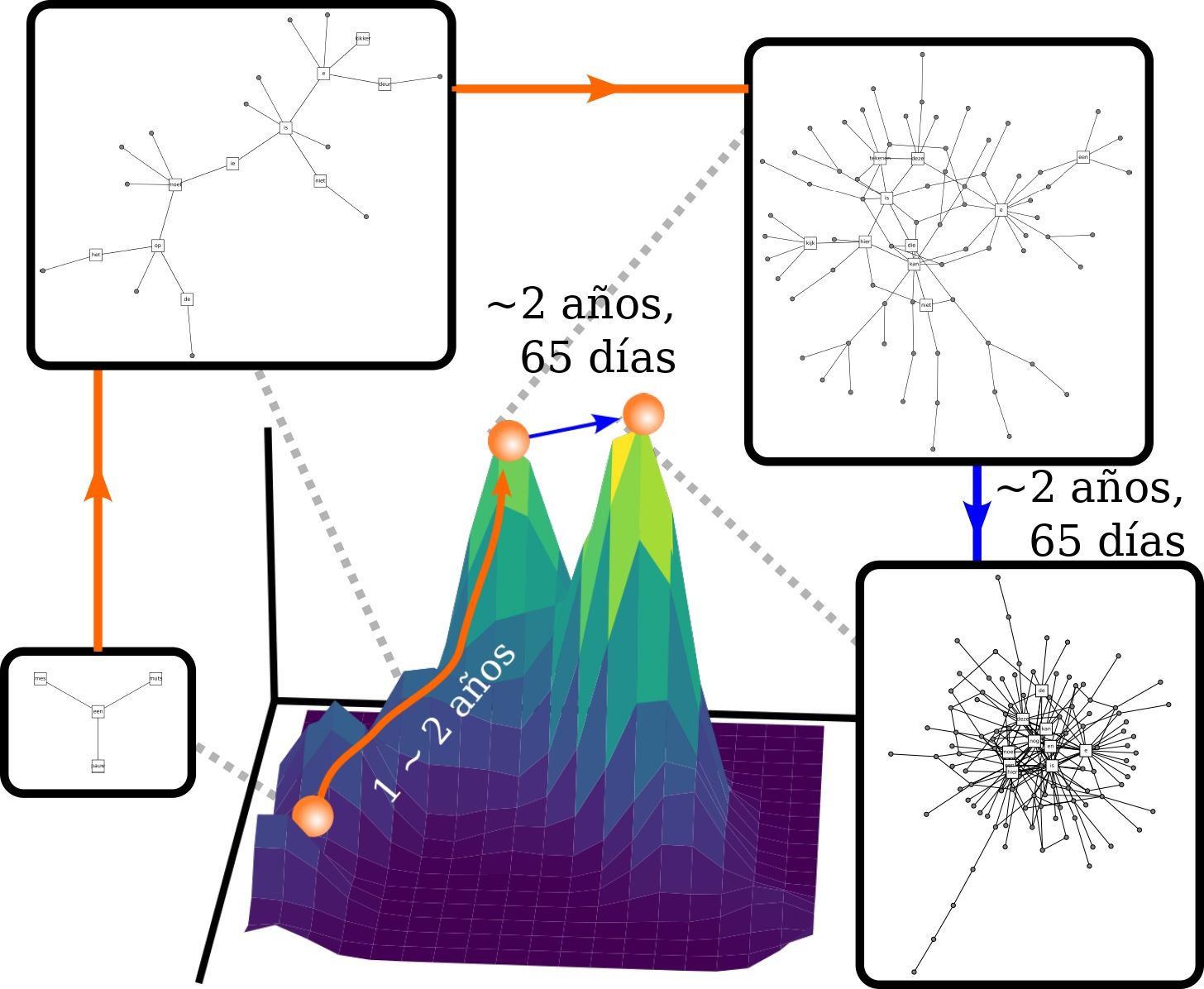
Image: Luis F. Seoane.
Reference article: Transitions between discrete developmental stages during language acquisition through syntax network morphospace; Physical Review Research 8, 023174 (2026); Lluís Barceló-Coblijn, Víctor M. Eguíluz and Luís F. Seoane.
About the Institute of Evolutionary Biology (IBE: CSIC-Universitat Pompeu Fabra): The IBE is a joint center of the Spanish National Research Council (CSIC) and Pompeu Fabra University (UPF), established in Barcelona in 2008. The IBE is dedicated to understanding the evolutionary mechanisms that generate and maintain biodiversity, with the potential to drive strategies for species conservation. It boasts a collaborative and multidisciplinary scientific team at the forefront of scientific and technical advances. To fulfill its mission, the IBE conducts innovative research spanning genomics, ancient DNA analysis, population dynamics, complex networks, and artificial intelligence. The IBE serves society with the ultimate goal of promoting planetary well-being through cutting-edge research and informing citizens about its scientific progress towards this global objective.
Cover Photo: Pexels