
Workshop: "Communicating Health Science: Key Principles and Resources"
Doing good science also means knowing how to communicate it. The course "Communicating Health Science: Keys and Resources" aims to help participants learn how to explain research in a clear, engaging and impactful way. This training is exclusively intended for staff affiliated with an IdISBa research group.
Format
In-person, to be held during a single morning (early September). Duration: 3 sessions of 1 hour and 30 minutes each.
Lecturers
- Cèlia Garau, researcher (neurophysiology, behavioural studies and biomarkers)
- Maitane Moreno, journalist
- Albert Xamena, science communicator
Course Objectives
- Understand the fundamentals of scientific communication.
- Learn how to communicate research to different audiences.
- Become familiar with science communication tools and channels.
Programme by Session
Session 1 (1 h 30 min)
Fundamentals of Scientific Communication
Lecturer: Cèlia Garau
Contents
Introduction to Scientific Communication
- What it is and why it matters.
- Its importance in maximizing research impact.
Types of Scientific Communication
- Academic, institutional and public communication.
Creating Scientific Content
- Popular science writing.
- Introduction to visual content.
Scientific Posters
- Structure and storytelling.
- Basic principles of visual design.
Methodology
Lecture with practical examples.
Session 2 (1 h 30 min)
Scientific Communication in the Media and Content Creation
Lecturer: Maitane Moreno
Contents
Oral Communication of Scientific Content
- Communicating with scientific vs. non-scientific audiences.
- Simplifying language without losing accuracy.
Working with the Media
- What journalists look for.
- How to create valuable content.
- Key tips for media interviews.
Methodology
Presentation based on real-life case studies.
Session 3 (1 h 30 min)
Science Communication on Social Media and Visual Content
Lecturer: Albert Xamena
Contents
Scientific Communication on Social Media
- The role of social media in science communication.
- Content types and formats.
Creating Visual Content
- The importance of visuals in scientific understanding.
- Basic design principles (hierarchy, clarity and contrast).
Storytelling in Digital Science Communication
- Turning scientific content into a compelling story.
Methodology
Examples of social media content and videos.
Assessment
Participants must pass a multiple-choice test and submit a short science communication project (one-page format) to obtain a certificate of achievement. The project will be assessed by the Communication Unit.
Registration deadline
4 September 2026 (Limited places available)
Share this event
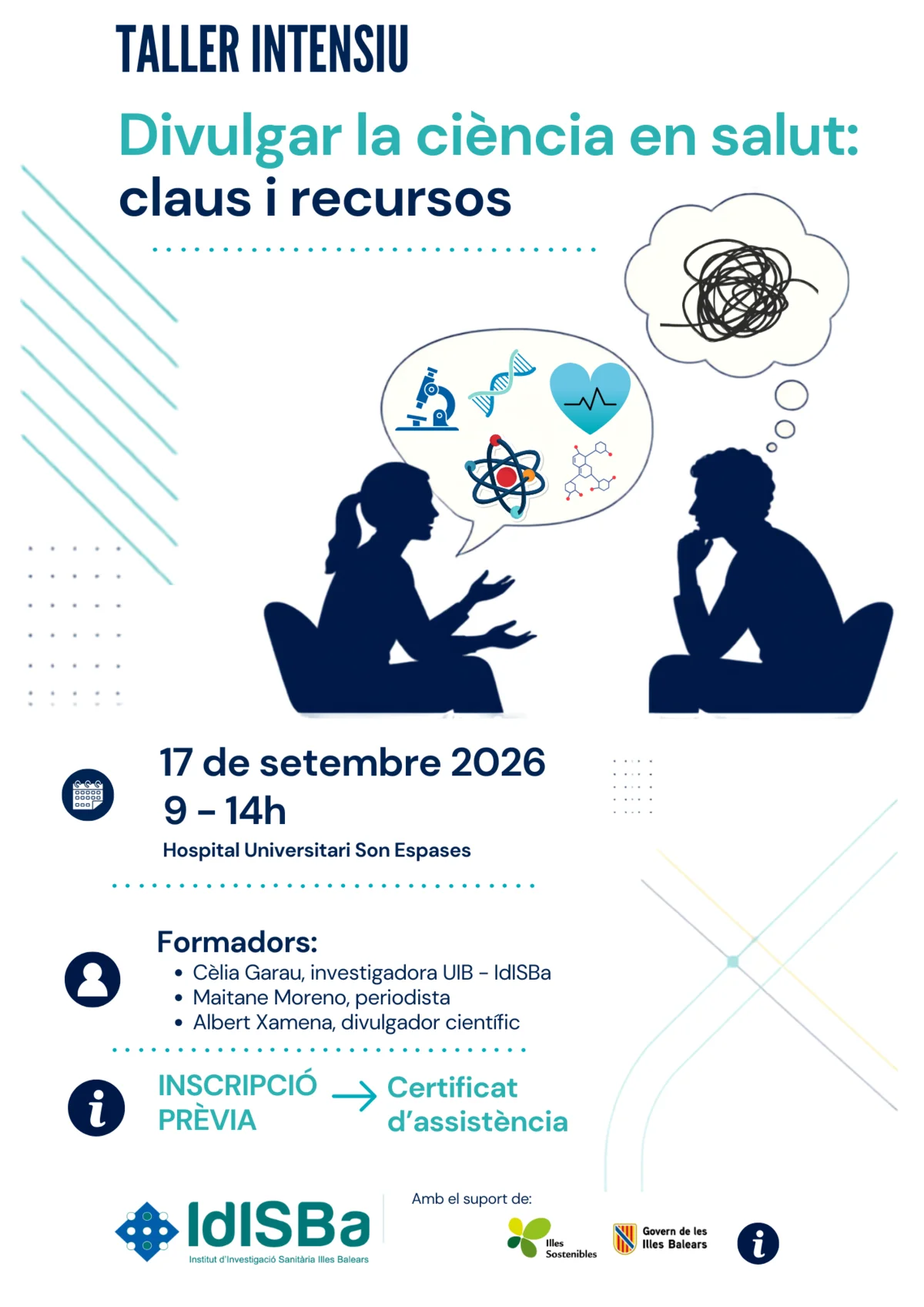
From 9 a.m. to 2 p.m.
Hospital Universitario Son Espases