
Implementation Science Workshop: Equity and Global Hearth
a { text-decoration: none; color: #464feb; } tr th, tr td { border: 1px solid #e6e6e6; } tr th { background-color: #f5f5f5; } Objective: The gap between what evidence shows works and what actually reaches practice remains one of the most persistent challenges in the health sector. Implementation science has emerged as a field dedicated to closing this gap by studying the methods, strategies, and conditions that enable evidence-based interventions to be adopted, adapted to local contexts, effectively implemented, and sustained over time.
This two-day international workshop brings together leading researchers in implementation science to explore the core concepts and current frontiers of the field, with a particular focus on equity and global health. The workshop combines conceptual, methodological, and applied perspectives and addresses key challenges such as adapting complex interventions, implementation strategies, context and complexity, mechanisms of action, co-creation, equitable scale-up, and sustainability in real-world settings.
Target audience: researchers, professionals, healthcare professionals, and postgraduate students working at the intersection of public health, global health, and implementation science.
Faculty:
- Rik Crutzen. Professor of Behaviour Change and Technology, Department of Health Promotion. Director of the Care and Public Health Research Institute (CAPHRI), Health Promotion and Personalised Care research line - Maastricht University (Maastricht, Netherlands).
- María E. Fernández. Vice President for Population Health and Implementation Science. Founding co-director of the Institute for Implementation Science. Lorne Bain Distinguished Professor of Public Health and Medicine. Director of the Center for Health Promotion and Prevention Research - UTHealth Houston, University of Texas (USA).
- Mónica Pérez Jolles. Associate Professor, Department of Pediatrics, School of Medicine. Member of the Adult and Child Center for Outcomes Research and Delivery Science (ACCORDS) - University of Colorado (USA).
- Lisa Pfadenhauer. Senior scientist. Director of the Chair of Public Health and Health Services Research, Institute for Medical Information Processing, Biometry and Epidemiology (IBE) - Ludwig Maximilian University (LMU) (Munich, Germany).
Programme:
- Fundamentals of implementation science.
- Addressing complex interventions.
- Core elements and programme theory.
- Design of implementation strategies.
- Equity and equitable scale-up.
- Context and complexity in implementation.
- Mechanisms of action in implementation science.
- Co-creation and stakeholder engagement.
- Theories, models, and frameworks in implementation science.
- Chronic disease prevention in primary care.
- Sustainability and real-world implementation.
Format and duration: on-site, 10 hours.
Location: Degree Hall, Margalida Comas Building, UIB Campus (Palma).
Registration: from May 25, 2026 to July 3, 2026 (inclusive)
Fee: general registration: €200 / master's and PhD students: €100
IMPORTANT: IdISBa has reserved 5 funded places for research staff classified as R2, R3, or R4 according to the "IdISBa Integration Plan 2025-2029".
IdISBa SELECTION AND FUNDING CRITERIA:
- Classification as an IdISBa researcher type R2, R3, or R4 according to the current Integration Plan.
- Applications will be accepted on a strict first-come, first-served basis.
- One application per group will be prioritised.
- When the number of applications exceeds the available places, participants will be selected according to institutional criteria.
- Researchers selected for funding will be reimbursed the course registration fee upon completion of the course and after submitting the certificate of attendance or completion to the IdISBa Training Unit.
REGISTRATION LINK 5 funded IdISBa places, until June 17 at 15:00
Share this event
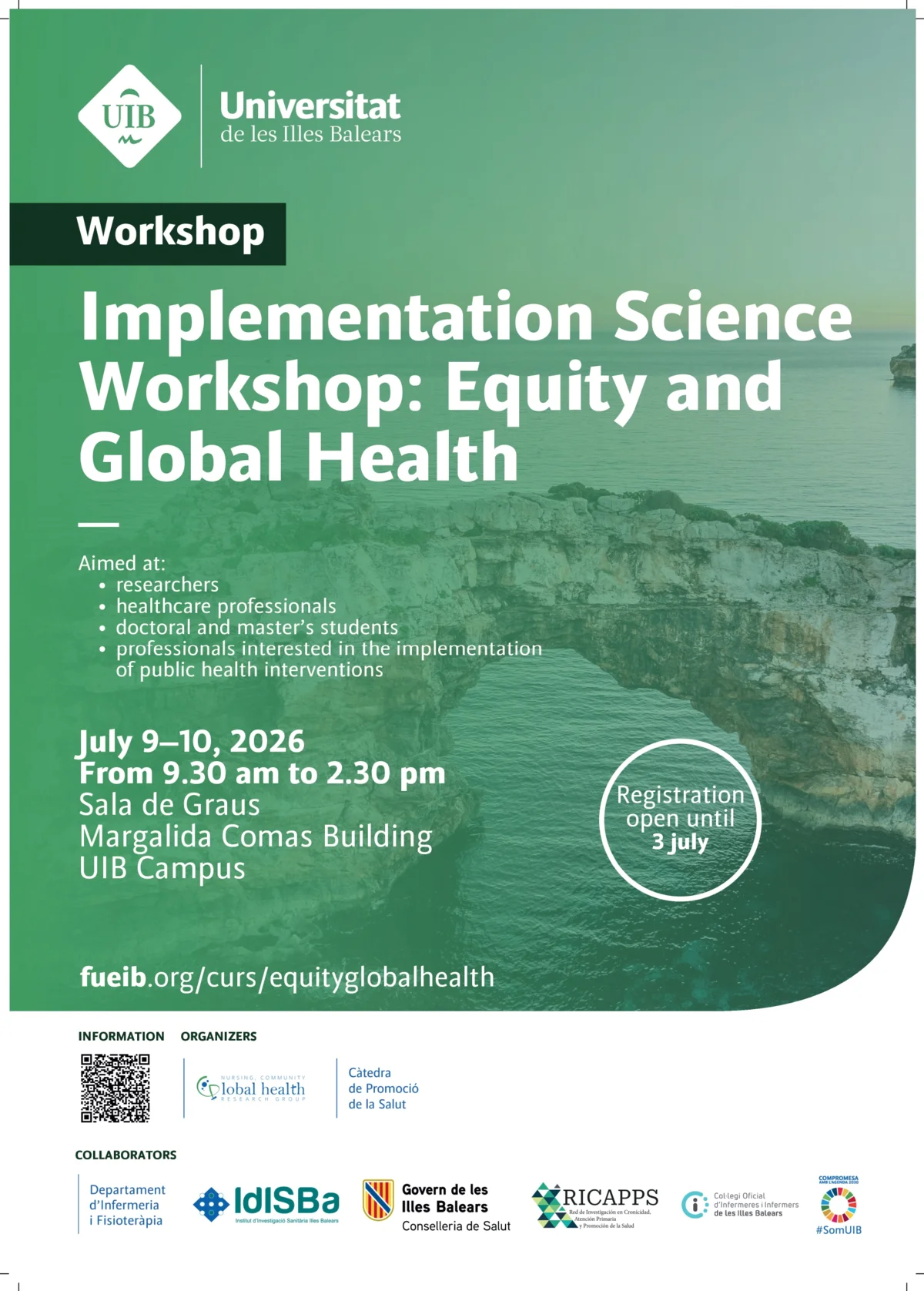
From 9:30 to 14:30
Degree Hall, Margalida Comas Building (UIB Campus)